Government to publish action plan on brain injury as study shows costs economy 1.5% of GDP
15 December 2025
(0 Comments)
Spokespeople:
Chloe Hayward,
Executive Director, UKABIF
info@ukabif.org.uk
, 0790 388 7655
Sir John Hayes MP, Chair, APPG on Acquired Brain Injury, ian.bettles@parliament.uk
-
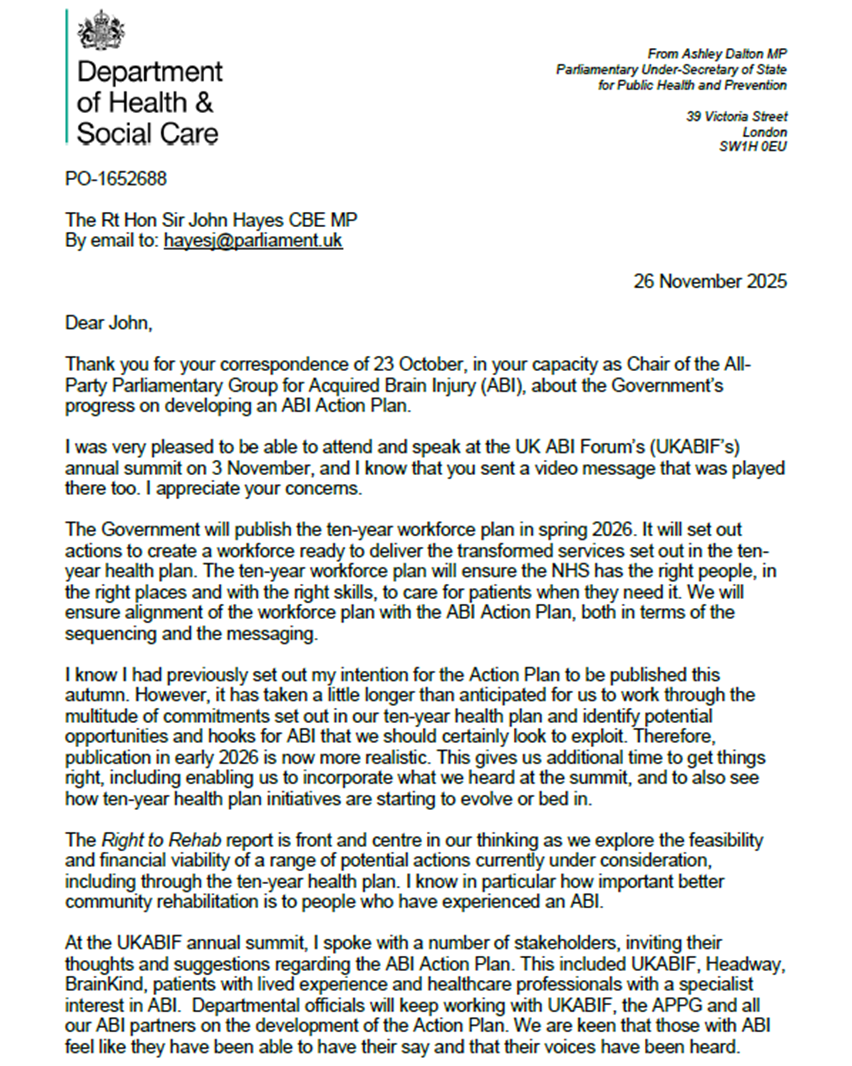
Letter from minister says action plan will be published by Spring 2026
- MPs and charity UK Acquired Brain Injury Forum highlight £43bn annual cost of brain injuries, and calls for ‘Right to Rehab’
A Health minister has revealed that the Government will publish an action plan on brain injury in 2026, after years of campaigning by charities and MPs.
In a letter to the Chair of the APPG on Acquired Brain Injury, Ashley Dalton MP, the Minister for Public Health and Prevention wrote that “publication in early 2026” is “realistic”. A debate on a comprehensive acquired brain injury action plan is scheduled to take place in Parliament on Thursday 4 December 2025.
Brain injury is the leading cause of disability and death for people aged 0-40 in the UK, with an estimated hospital admission rate of one person with a brain injury every 90 seconds.
The previous Government committed to publish a strategy on Acquired Brain Injury in 2021, but it was never published.
A report from earlier this year,
Right to Rehab, commissioned by the APPG and the charity UKABIF, urged the Government to invest in specialist neuro-rehabilitation to save in long term societal costs.
Acquired brain injury (including trauma, stroke and tumours) costs the UK an estimated £43bn a year—1.5% of GDP—through healthcare, social care, lost productivity and wider public services. The report argued that
brain injury should be treated on a par with cancer and dementia, with a statutory Right to Rehab
in every region, a national strategy, and better data to end the postcode lottery in care. The report highlights evidence of a 16:1 return on investment—£43,000 generating £680,000 savings per patient.
The Minister’s letter
says:
“The Right to Rehab report is front and centre in our thinking as we explore the feasibility and financial viability of a range of potential actions currently under consideration, including through the ten-year health plan. I know
in particular how important better community rehabilitation is to people who have experienced an ABI.”
There are around 350,000 admissions to hospitals in the UK of people with an acquired brain injury and
up to 60% of prisoners have experienced a traumatic brain injury
.
Sir John Hayes MP, Chair of the APPG, who in his youth experienced a brain injury, said:
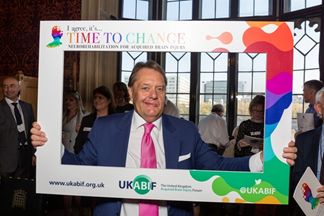
“Brain injury doesn’t just change lives — it drives huge costs across society. If we want to tackle addiction, mental health crises and violence, we must start with the root cause: brain injury. It is time that people are given a right to specialist rehab close to home, and in doing so, we can save money while transforming lives.”
Chloe Hayward, Executive Director of UKABIF,
said: “This is very welcome news. Rehab isn’t a cost — it’s an investment. It cuts NHS and social care spending, boosts employment, and helps individuals and families.It transforms lives and strengthens communities — the benefits ripple out to everyone.”
Dr Alyson Norman
 , a psychology academic at the University of Plymouth, lost her brother Dave after a lifetime of untreated brain injuries led to addiction, homelessness and eventually suicide. A review revealed “mild” injuries
from childhood — including a road accident at three — that were never followed up.
, a psychology academic at the University of Plymouth, lost her brother Dave after a lifetime of untreated brain injuries led to addiction, homelessness and eventually suicide. A review revealed “mild” injuries
from childhood — including a road accident at three — that were never followed up.
“When I learned what was in his records, I went numb,”
she says. “I’d always blamed our background. Despite my expertise, I had been flying blind.”
Her own research into 600 serious case reviews found that nearly a third may involve brain injury, often linked to violence or road accidents. Yet support is patchy, and those affected can seem outwardly fine — even though they are three times more likely to take their own lives.
“Specialist community neurorehabilitation could have picked up the issues that led to his downward spiral,”
Alyson says.
References
- On 2 December 2021 the government committed to publishing an acquired brain injury strategy. Acquired brain injury call for evidence -
GOV.UK
- A debate on a comprehensive acquired brain injury action plan is scheduled to take place in Westminster Hall on Thursday 4 December 2025. The debate was scheduled by the Backbench Business Committee and will be led by Sir John Hayes MP.
Comprehensive acquired brain Injury action plan - House of Commons Library
- Link to APPG / UKABIF report Hidden toll of brain injury costs economy £43 billion a year - United Kingdom Acquired Brain Injury Forum
- Acquired brain injury is the leading cause of death and disability for people aged under 40 in the UK Traumatic Brain Injury - an overview | ScienceDirect Topics
- There are around 350,000 admissions to hospitals in the UK of people with an acquired brain injury. https://www.headway.org.uk/about-brain-injury/further-information/statistics/
- Up to 60% of prisoners have experienced a traumatic brain injury. https://www.psych.ox.ac.uk/news/up-to-60-per-cent-of-prisoners-have-head-injuries-as-experts-warn-brain-damage-may-fuel-crime
There is a postcode lottery in neuro-rehab commissioning - A review of NHS services in the East of England by academics at Loughborough and Essex Universities found that rehabilitation in the region was “variable, inequitable and under-resourced”.
https://www.researchgate.net/publication/384928434_Navigating_Rehabilitation_Inequalities_An_Analysis_of_Rehabilitation_Provision_over_the_East_of_England
|

 Email to a Friend